
In the fail-fast tech industry, being able to get a new job is important. Every day, start-ups fold, companies get disrupted, some jobs get eliminated and new ones open up. Working in tech means regularly asking yourself:
- Should I get a new job, or stick it out at my current one?
- Are my skills still relevant?
- Should I move myself or my family for a new job opportunity?
- Can I get a work visa if I move?
These are big questions. We can’t answer all of them. However, to help answer some of them, we share salary trends based on pre-pandemic data from tech workers on H-1B status1.
The purpose of this blogpost is to provide useful information for im/migrant tech workers, although others may find the industry trends interesting and useful as well.
What is H-1B?
Every year, tens of thousands of people make a huge decision. They move across the world to work in the US tech industry, primarily through the H-1B visa program. Being on H-1B means that a company sponsors your legal right to be in the US. If the company lays you off, then your legal status would be in jeopardy.
The H-1B is a non-immigrant visa. This means those who want to have a political voice and stay in the US long term must separately apply for permanent residency (green card) and citizenship. Because of the wait times baked in to green-card process, workers often are forced to stay with the same company for a long time to maintain their legal status during the wait.
Denial rates
The first step in getting an H-1B visa is to win the lottery. A limited number of H-1B visas are available each year and distributed through a lottery system. The odds of winning the lottery vary from year to year, but historically, have been around 1/3 for people without Masters, and 2/3 for people with Masters degrees or higher.
After winning the lottery, applicants and their employer-sponsors must submit petitions to the US federal government for approval. Historically, the federal government approved the vast majority of these petitions, and only a small percentage of 2-6% were denied. However, in recent years, under the Trump administration, the denial rates have increased a lot, up to 25%.
Is this increase in denial rates temporary? Compared to data from the last 15 years, the recent Trump-era denial rates have no historical precedent, so we’re reasonably hopeful that the denial rates would go back to normal if Trump loses the 2020 election. However, if Trump wins, then it’s also hard to tell if the denial rates would keep increasing or plateau. Take a look at the graph for yourself.
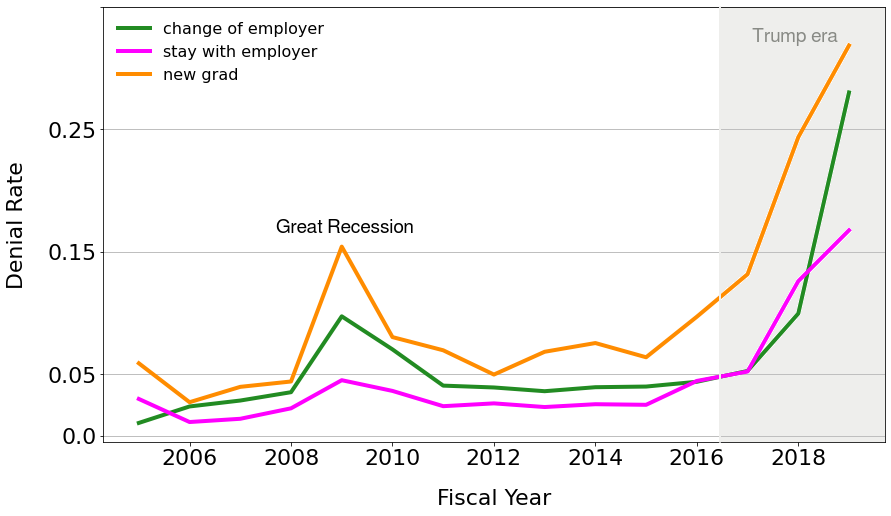
In the graph above, we split the data based on petition type. The petition types have specific, legal definitions2, but broadly speaking, we can think of the 3 petition types as:
- New grad: A new college, Masters or PhD graduate applying to work for a US company for the first time
- Stay with employer: An experienced employee applying to renew their visa because it’s expired, they’ve gotten a raise or promotion, changed offices, or are at a new consulting on-site
- Change of employer: An experienced worker gets a job at a new company and applies to transfer the visa from the old company sponsor to the new one
The impact of Trump-era denial increases is most severe for new grads and workers changing employers. Denial rates for:
- change of employers increased 24%
- new grads increased 22%
- stay with employers increased 12%.
Salary trends
Software engineers
The graph below shows the median salary for software engineers on H-1B over the last 15 years.
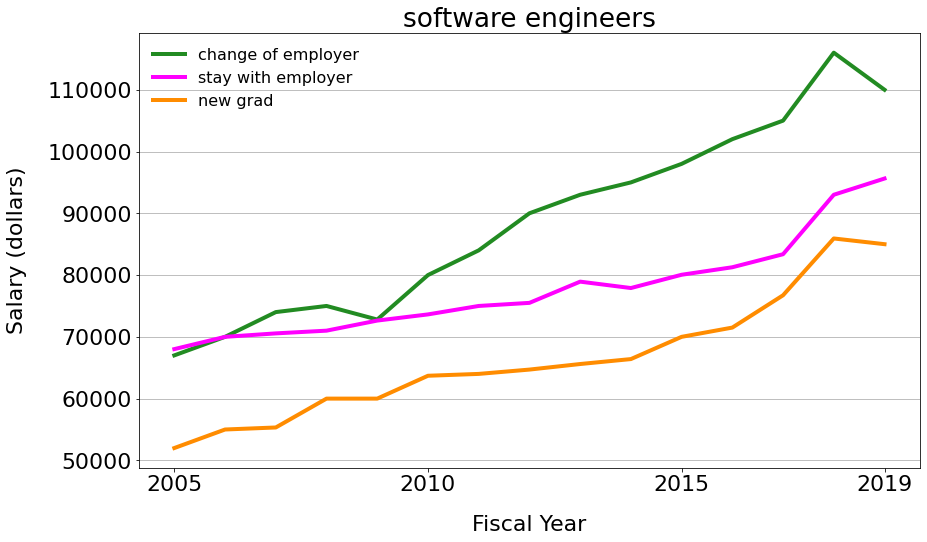
From the data, we see that, not only does changing employers pay the most, but those salaries have also grown the most–growing by ~$43k over the last 15 years. Salaries for new grads have also grown by ~$33k, the second most. Salaries for workers staying with the same employer, however, have only grown by ~$28k.
The fact that salaries for new grads have grown more than salaries for workers staying with the same employer is important. It shows that companies aren’t compensating employees for their loyalty and experience as much as they used to. US companies will pay at the beginning to attract new im/migrant software engineers (whether new grads or from another company), but over the years, devalue them.
We see this devaluation in the graph by the fact that the orange line catches up with the pink line.
Other tech professions
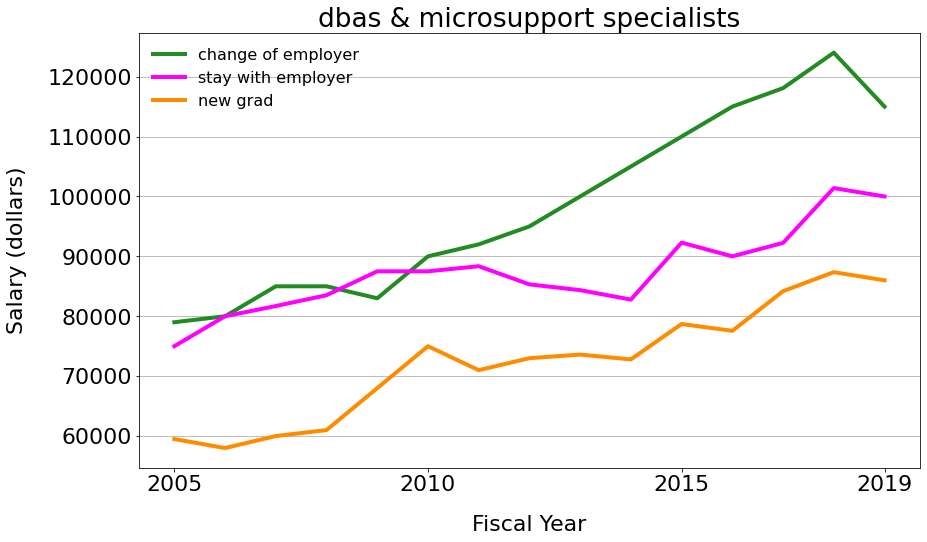
For electrical and electronics engineers, database admins and microsupport specialists, we see similar trends of employers paying the most to attract workers away from other companies. However, for these jobs, loyal employees are not devalued as much as software engineers are, relative to new grads. (The lines are roughly parallel, and the orange line does not catch up with the pink line.)

Non-tech professions
We show the salaries of two non-tech professions for comparison.
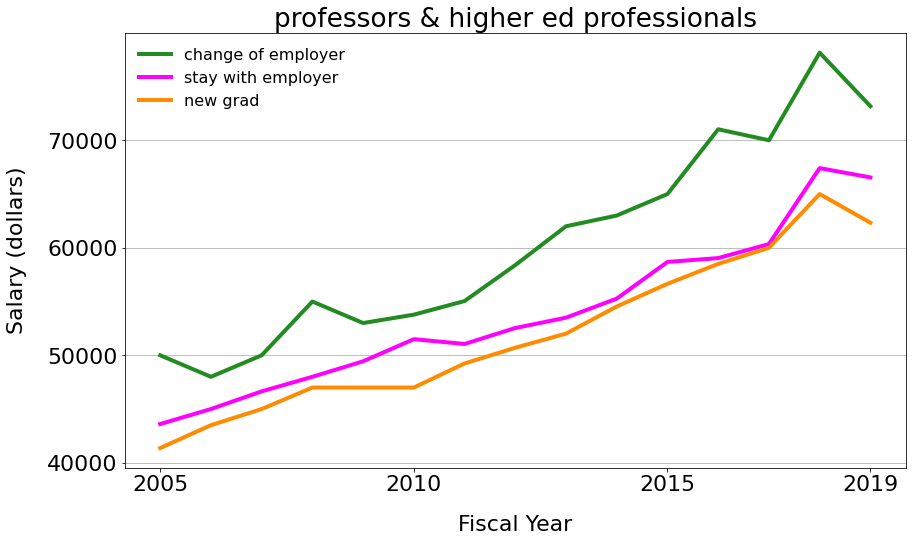
For professors and higher-ed professionals (not including grad students), staying at the same institution means almost no increase in salary. (Pink line is very close to the orange line.)
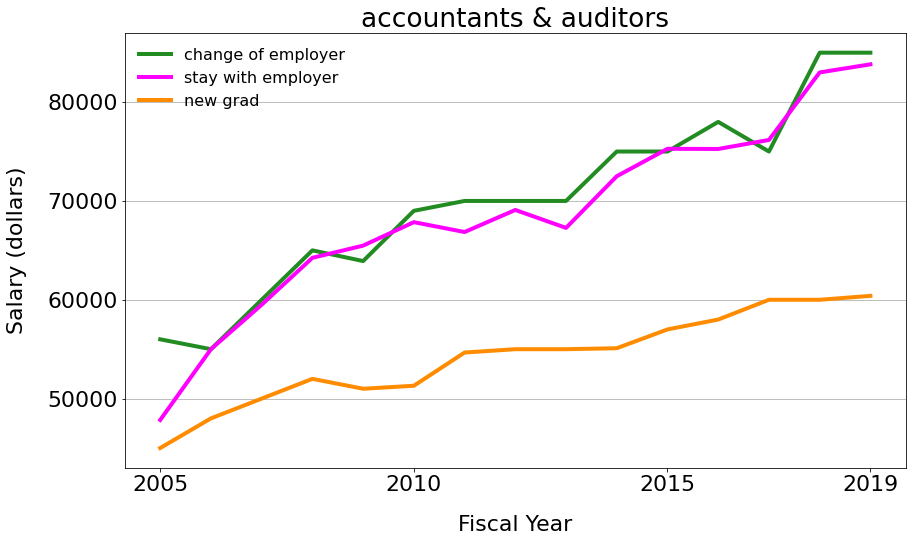
For accountants and auditors, companies do not pay extra to attract workers away from their existing companies. (Pink line is very close to the green line.)
Salaries for software engineers by company
There are over 14,000 companies employing software engineers on H-1B each year. We discuss some common patterns among them.
Devaluing loyal and experienced workers
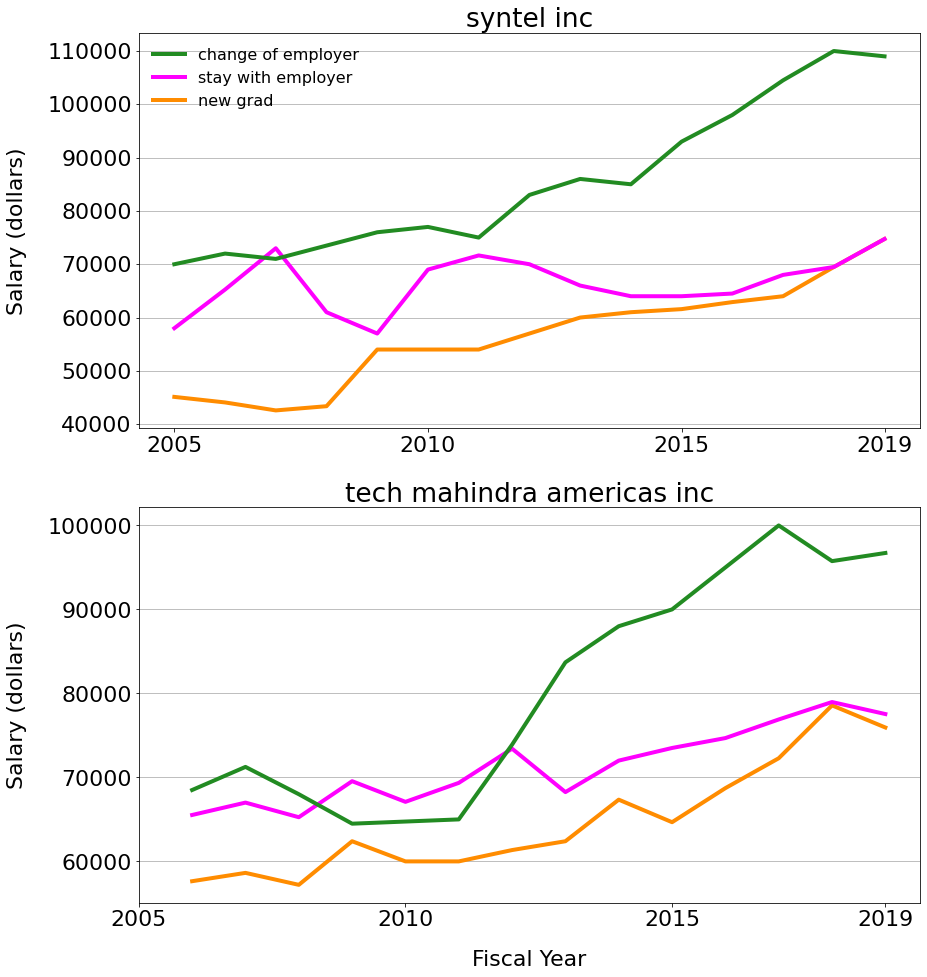
For companies like Tech Mahindra and Syntel, we see the same pattern as above of devaluing employees who stay with the same company relative to new hires. (Orange line catches up with the pink line.)
No raises
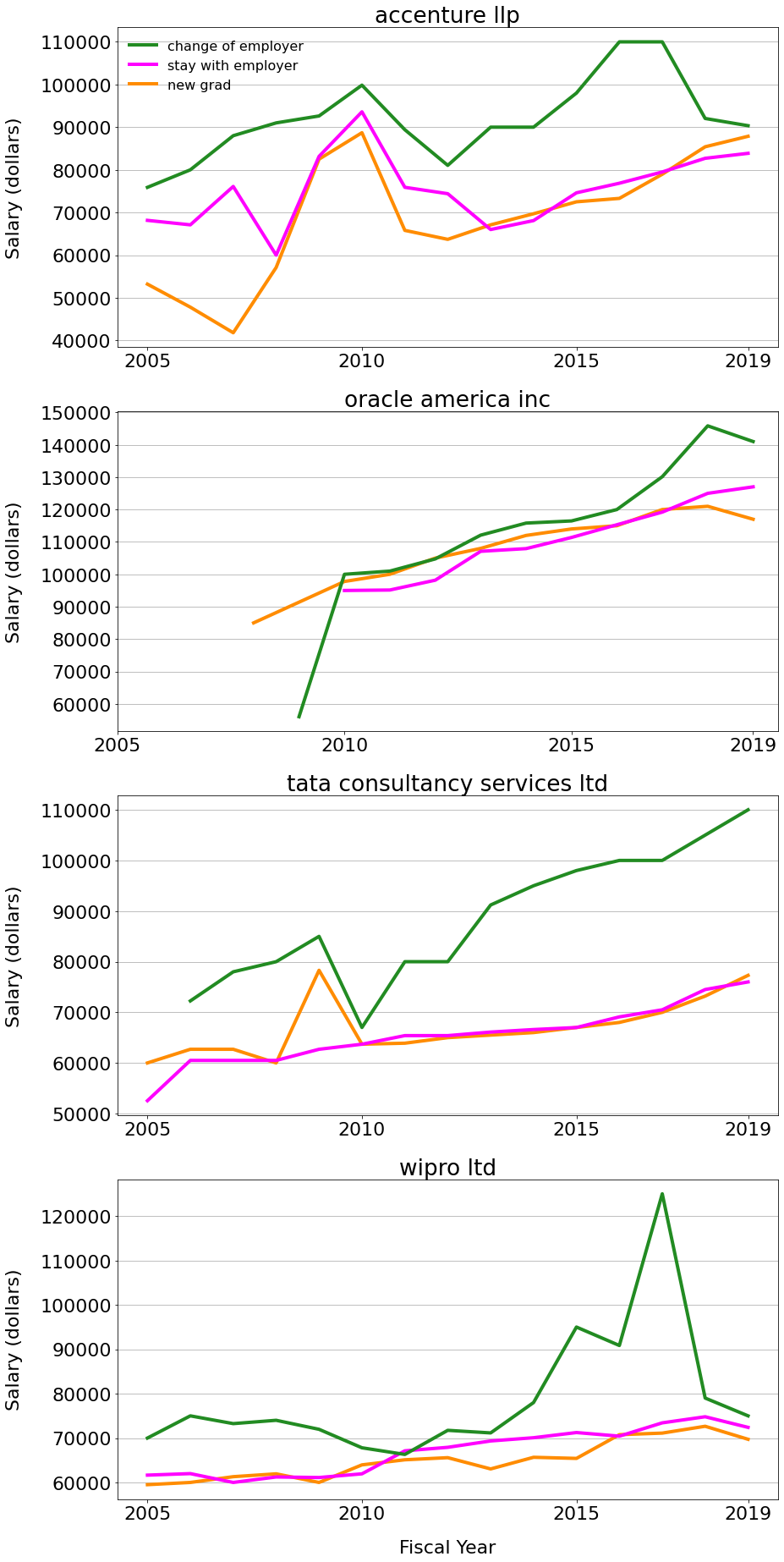
These companies pay new grads the same as employees who stay with the company: Accenture, Oracle, Tata, Wipro. (Pink and orange lines are close together.)
Raises that keep up with the market
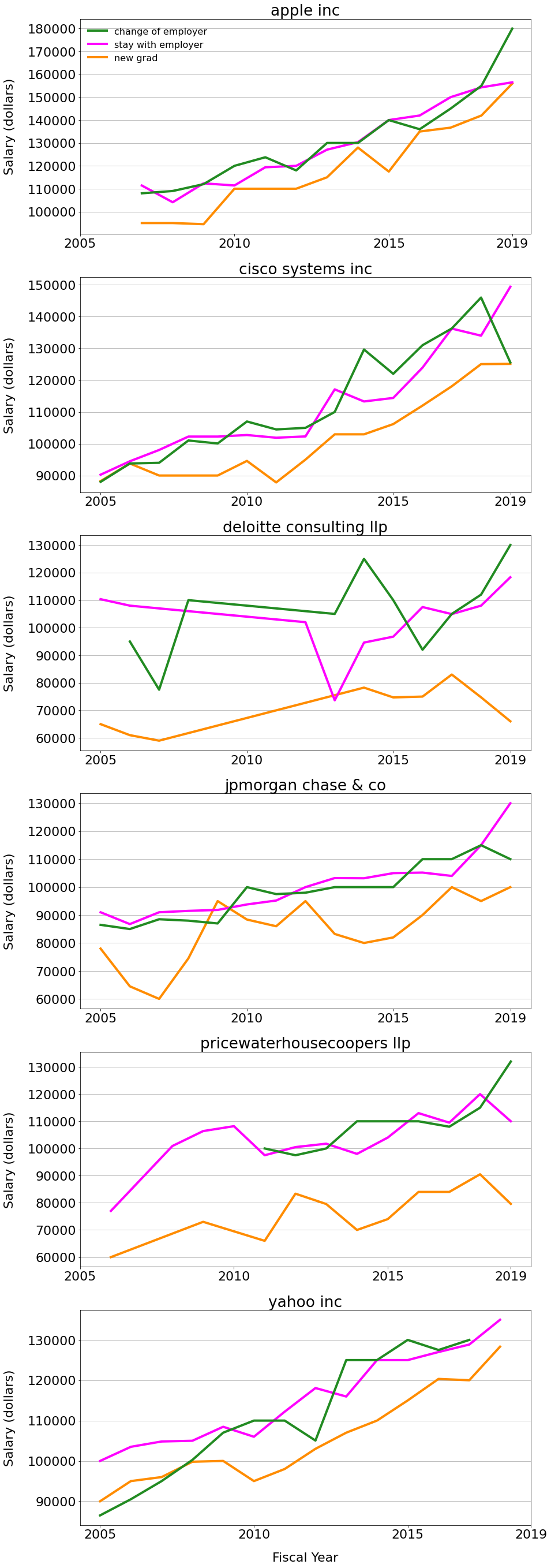
Employers usually have to pay workers extra to convince them to leave their current company sponsor. However, these employers pay workers who stay comparably to those they’ve attracted from other companies: Apple, Bank of America, Chase, Cisco, Deloitte, Ernst & Young, PWC, Yahoo. (Pink and green lines are close together.)
Good retention incentives
These companies pay the most to people who stay, even more than new hires attracted from another company: Facebook, Goldman Sachs, Google, IBM. (Pink line is above the green line.)

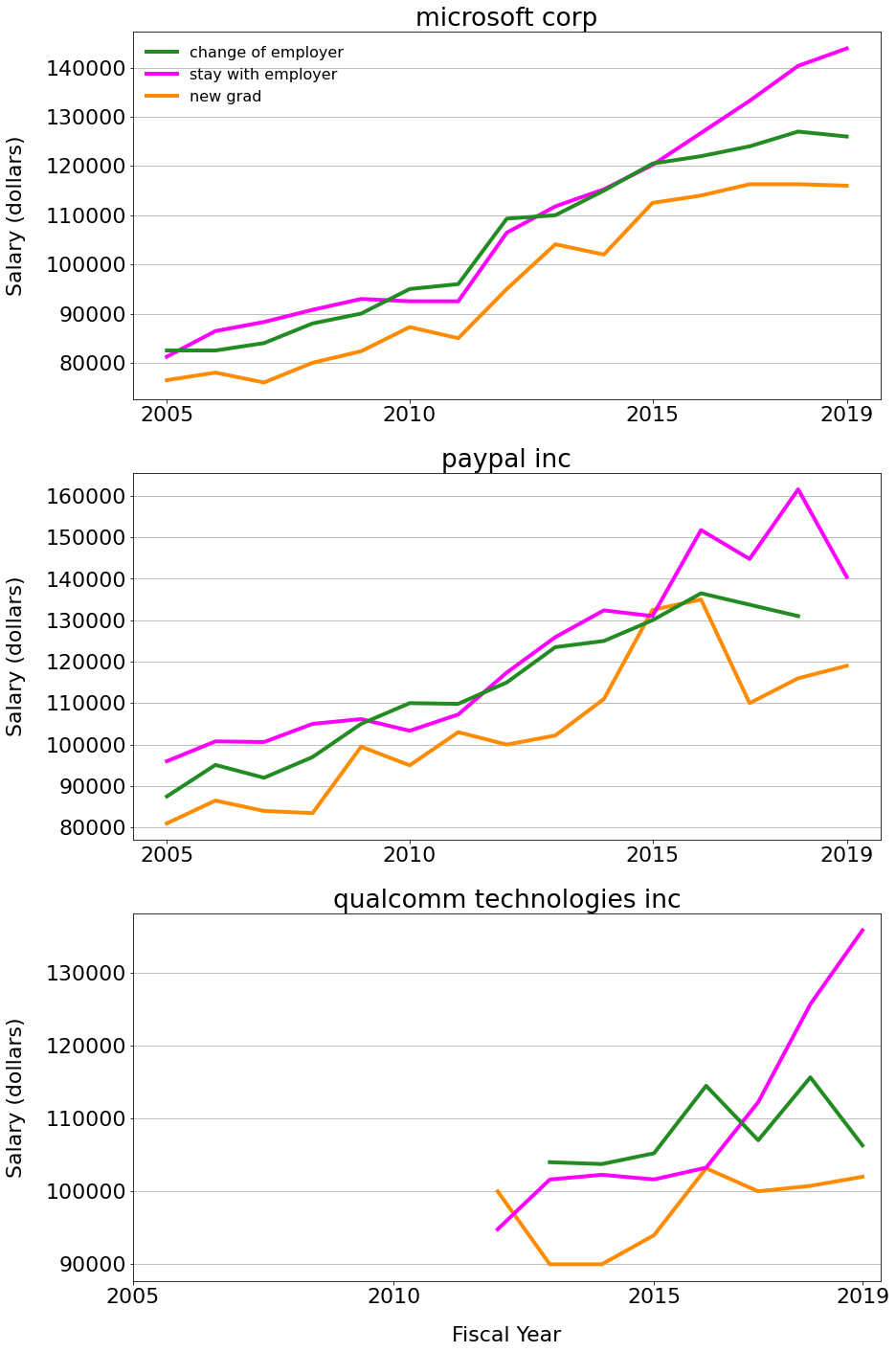
A few companies have started doing this recently, only in the last 4 years: Microsoft, PayPal, Qualcomm. (Pink line is above the green line during the most recent 4 years.)
Paying new grads less
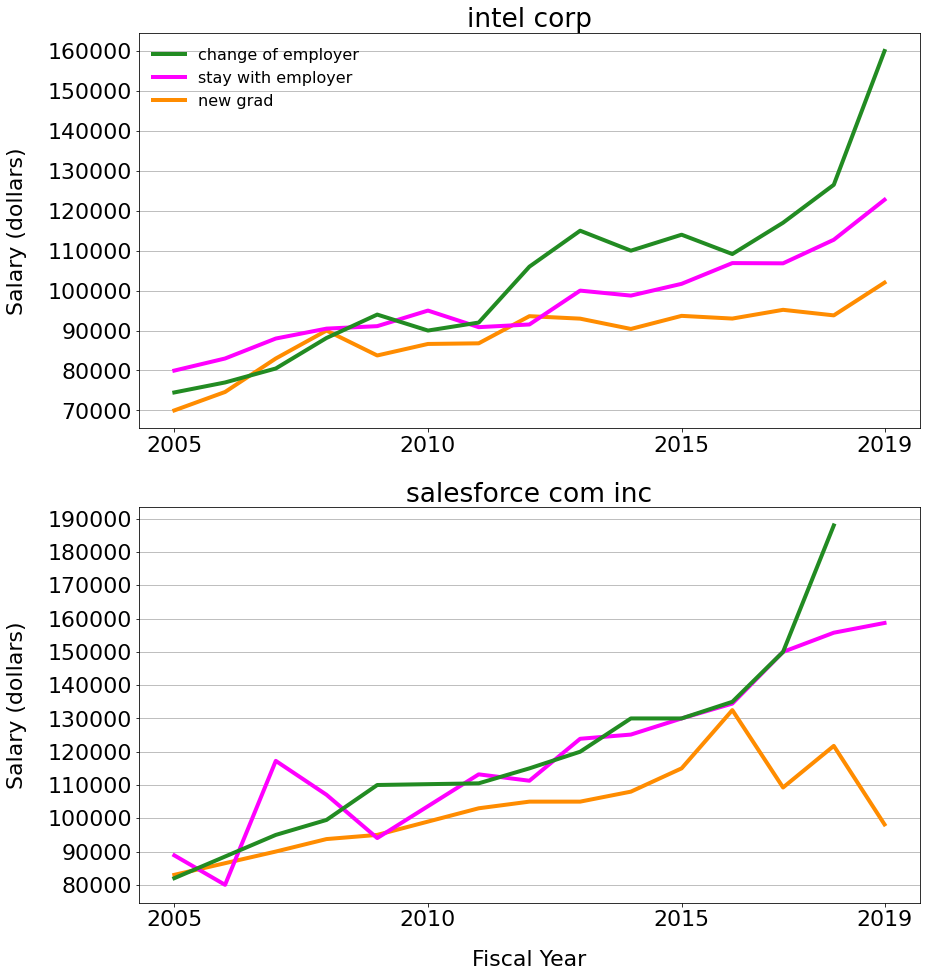
Salaries for new grads at Intel and Salesforce have stayed relatively flat or gone down in recent years. (Orange line flat or downward-trending.)
Wrap-up
So, should you get a new job? The answer depends on your occupation and the hiring company. For most tech workers, changing employers means a significant increase in salary while staying with the same employer amounts to being devalued over time. However, for accountants or those at companies with good retention incentives, staying with the same company could be the more reliable choice.
The graphs above show a variety of trends and patterns within the tech industry. May they support and help inform your personal and collective decision-making.
Footnotes
-
Data from: US Customs and Immigration Services (2019). Electronic Reading Room, H-1B visa petitions for FY 2005 to FY 2019. Retrieved 2020-10-13 from here. ↩
-
In more specific terms, the 3 petition categories are:
New grad: A new H-1B petition for someone applying for H-1B for the first time, or switching to H-1B from a different visa type. Petitions classified as ‘New employment’ by USCIS.
Stay with employer: Petitions classified as ‘Continuation of previously approved employment without change with the same employer’, ‘Change in previously approved employment’ or ‘Amended petition’ by USCIS.
Change of employer: Petitions classified as ‘Change of employer’ by USCIS.
For more on USCIS’s petition categories, see page 4 of USCIS Form I-129 Instructions. ↩